


There’s a common narrative in higher education and enterprise IT right now: PeopleSoft is old, therefore it’s the problem. I’ve written about it before: that assumption quietly drives SaaS-first strategies, rushed migrations, and decisions that often create new problems rather than solving old ones.
The reality is this:
PeopleSoft didn’t fail us.
Our operating model failed PeopleSoft.
When organizations struggle with PeopleSoft, the root cause is rarely the software itself. It’s almost always the way we deploy, govern, and own it. If you moved this same legacy mindset and operating model to any other ERP, it would look slow, brittle, and outdated, too.
Legacy Thinking Creates “Legacy Systems”
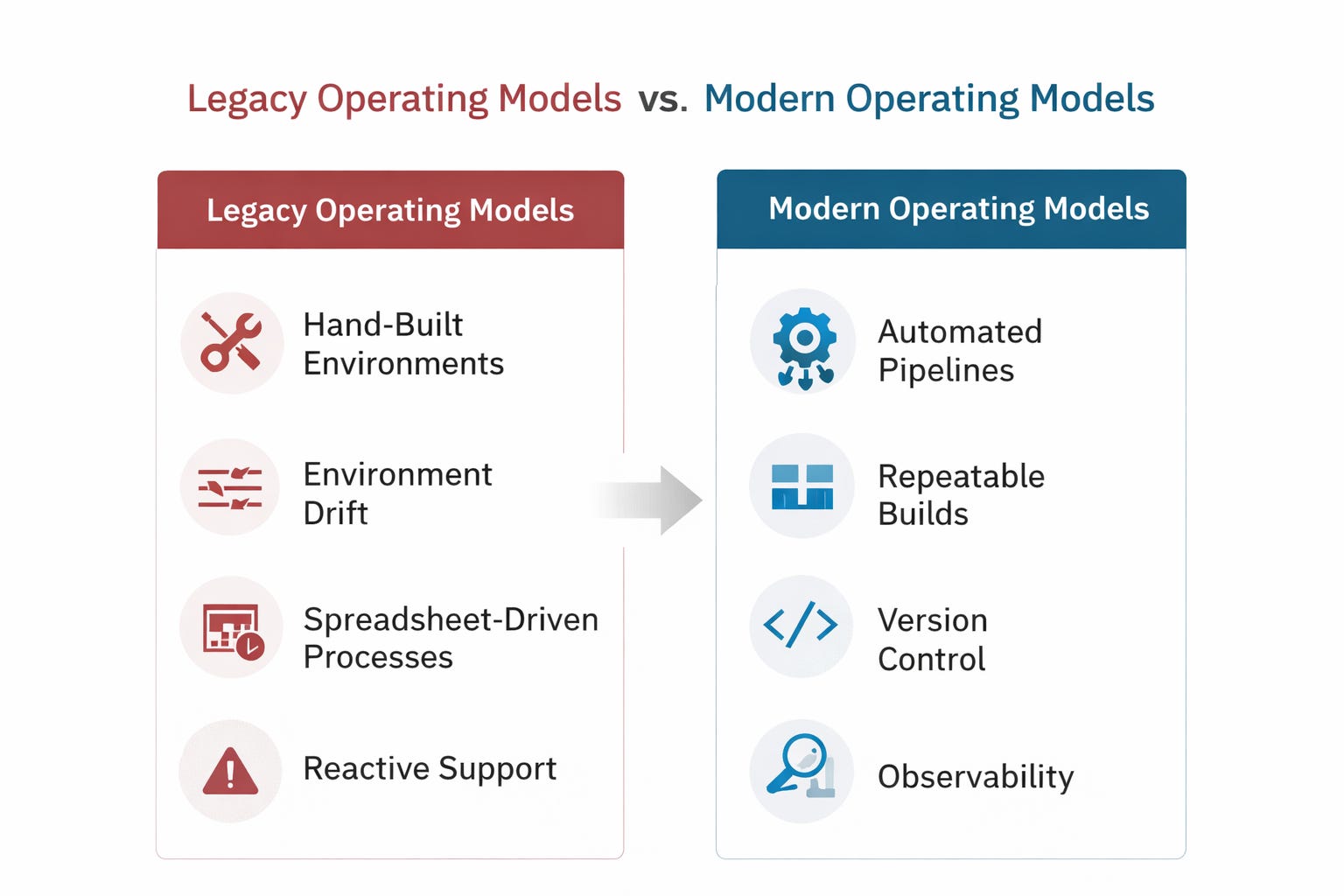
For years, many PeopleSoft environments have been run with habits formed in a very different era:
* Manual builds that only one or two people understand.
* Environment drift that makes every change risky.
* Release processes held together by spreadsheets and tribal knowledge.
* Monitoring that relies on users reporting problems after the fact.
None of that is a PeopleSoft limitation. That’s an operating model problem.
If you applied those same practices to a modern SaaS-adjacent platform, it would degrade just as quickly. Complexity compounds when discipline is missing.
Modernization Is an Operating Shift, Not a Rip-and-Replace
True PeopleSoft modernization starts with a mindset shift: treating PeopleSoft as a platform, not just an application.
Platform thinking changes the questions leaders ask. Instead of “How fast can we get off PeopleSoft?” the question becomes “How do we operate this platform in a modern, resilient way?”
That leads directly to fundamentals:
* Automation instead of hand-built environments
* Repeatable infrastructure instead of one-off fixes
* Version control instead of shared folders
* Observability instead of reactive troubleshooting
When these elements are in place, PeopleSoft behaves very differently. Deployments become predictable. Failures become visible early. Teams spend less time firefighting and more time improving.
Governance and Ownership Matter More Than Tools
Another quiet failure point is ownership. In many organizations, PeopleSoft sits in an awkward gap between infrastructure, applications, and the business. No single group owns the full lifecycle, so decisions get fragmented and slow.
Modern platforms require clear ownership models. Someone must be accountable for how the system is built, operated, secured, and improved over time. Without that clarity, even the best tooling can’t compensate. This is why many “modernization” efforts stall. They focus on technology choices while leaving governance untouched.
The Real Question Leaders Should Be Asking
The most important question isn’t whether PeopleSoft is still viable.
It’s this: Are we operating it in a way that would succeed on any platform?
If the answer is no, moving to the cloud or to SaaS won’t fix the underlying issue. It will just shift the pain and usually increase the cost.
PeopleSoft didn’t fail us.
Our operating model failed PeopleSoft.
And the good news is that operating models can be redesigned, without starting over. If you fix the operating model, PeopleSoft is a differentiator, not an anchor.