


The Q&A — one PeopleSoft question, answered straight
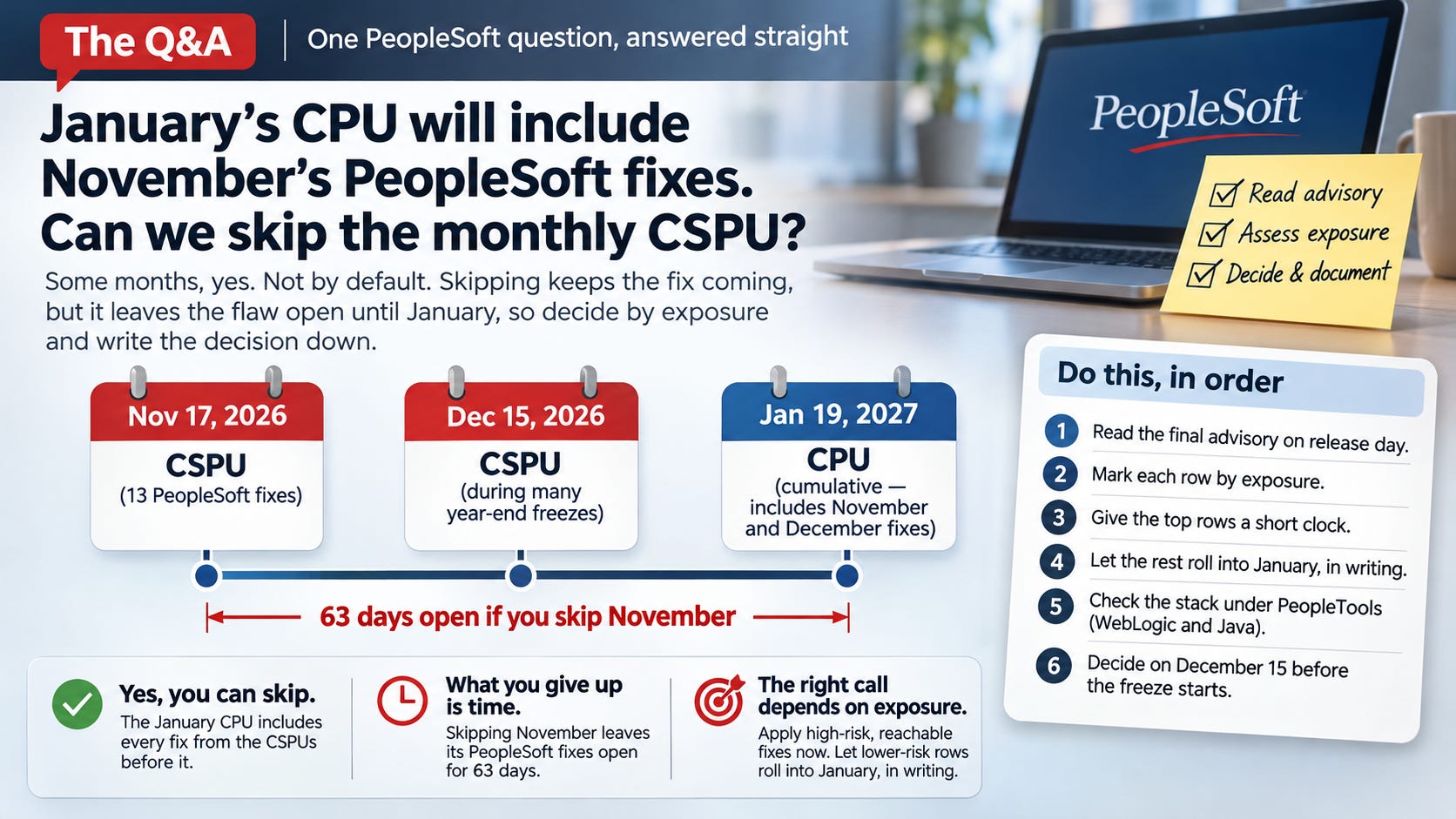
The short answer: You can skip a CSPU and still get its fixes in January, because Oracle’s quarterly CPUs include every fix from the CSPUs before them. What you give up is time. If you pass on the November 17 CSPU, its PeopleSoft fixes stay open for 63 days, until January 19. That’s an acceptable trade for some rows and the wrong one for others, so decide each month, by row.
What changed
Oracle started the monthly Critical Security Patch Update program in May 2026. CSPUs ship on the third Tuesday of the months without a quarterly CPU: February, March, May, June, August, September, November and December. Oracle’s policy page says “Quarterly Critical Patch Updates remain cumulative, including all fixes released in prior Critical Security Patch Updates.”
The November CSPU ships Tuesday, November 17. Oracle’s pre-release lists 13 PeopleSoft patches. Five may be exploited over a network without credentials, and the top CVSS v3.1 score is 9.3. Affected versions are PeopleTools 8.61 through 8.63. The same release has 71 Fusion Middleware patches, including WebLogic, and 11 for Java SE.
The next CSPU is December 15, which falls during many year-end freezes. The next CPU is January 19, 2027.
This year already showed what open days cost. CVE-2026-35273 in PeopleTools was exploited from May 27, before Oracle’s June 10 Security Alert shipped a fix. A skipped CSPU is a different case: the fix exists, and the open days are a decision someone made.
What to do, in order
Read the final advisory on release day. Oracle says the pre-release can change. Pull the PeopleSoft risk matrix on November 17 and list each CVE with its component, CVSS and whether it needs authentication.
Mark each row by exposure. Is the affected component on a tier someone can reach from outside your network, such as the web server, Integration Broker gateway or a self-service portal? Rows that are unauthenticated and reachable go to the top.
Give the top rows a short clock. Apply the CSPU, or put a mitigation in place within days and patch in your next window. Don’t let a reachable, unauthenticated 9.3 wait 63 days.
Let the rest roll into January, in writing. For rows that need credentials or sit on internal-only tiers, waiting for the CPU can be reasonable. Write down the CVEs, the reason, the compensating control and the date it ends: January 19.
Check the stack under PeopleTools. The WebLogic and Java rows in the same CSPU apply to the middleware your PeopleSoft runs on. Compare the affected versions to what your DPK delivered.
Decide on December 15 before the freeze starts. Either the freeze has a written exception for security fixes, or someone signs off that December’s rows wait until January.
My read: “We’ll get it in the quarterly” is a fine answer once you’ve read the rows. Before that, it’s a guess about risk you haven’t looked at.
Who owns it
PeopleSoft technical lead: reads the advisory on release day and sorts the rows.
Security lead: confirms which tiers are reachable and approves any mitigation.
Middleware team: owns the WebLogic and Java rows.
Change manager: keeps a security exception in the December freeze.
CIO or IT director: signs every “wait for January” decision, with an end date.
For leaders, in one line: Ask your team which of Tuesday’s 13 PeopleSoft fixes they’re holding for January, and who signed off on each one.
Got a PeopleSoft question? Reply to this email or leave a comment. I’ll pick one for a future Q&A and answer it straight.
Subscribe at peoplesoftcloud.com.
Sources
🔗 Oracle Critical Security Patch Update Pre-Release Announcement – November 2026 (Oracle) https://www.oracle.com/security-alerts/cspunov2026.html
🔗 Security Fixing Policies (Oracle) https://www.oracle.com/corporate/security-practices/assurance/vulnerability/security-fixing/
🔗 Critical Patch Updates, Critical Security Patch Updates, Security Alerts and Bulletins (Oracle) https://www.oracle.com/security-alerts/
🔗 Oracle Security Alert Advisory – CVE-2026-35273 (Oracle, Jun 10, 2026) https://www.oracle.com/security-alerts/alert-cve-2026-35273.html