


Many ERP roadmaps fail not because of poor execution, but because they start with the wrong premise. Organizations often begin by selecting a target platform or committing to a migration path before fully understanding their current state. This approach creates momentum without clarity, which leads to misaligned expectations and unnecessary risk. A roadmap built on assumptions rather than evidence rarely holds up in the real world. For CIOs, the starting point must be strategic intent, not technology selection.
A strong roadmap reflects how the organization wants to operate in the future. It connects business priorities to technology capabilities in a measurable, adaptable way. Without this alignment, even well-funded initiatives struggle to deliver meaningful outcomes. ERP modernization should not be treated as a one-time project. It should be structured as a continuous evolution guided by clear decision points.
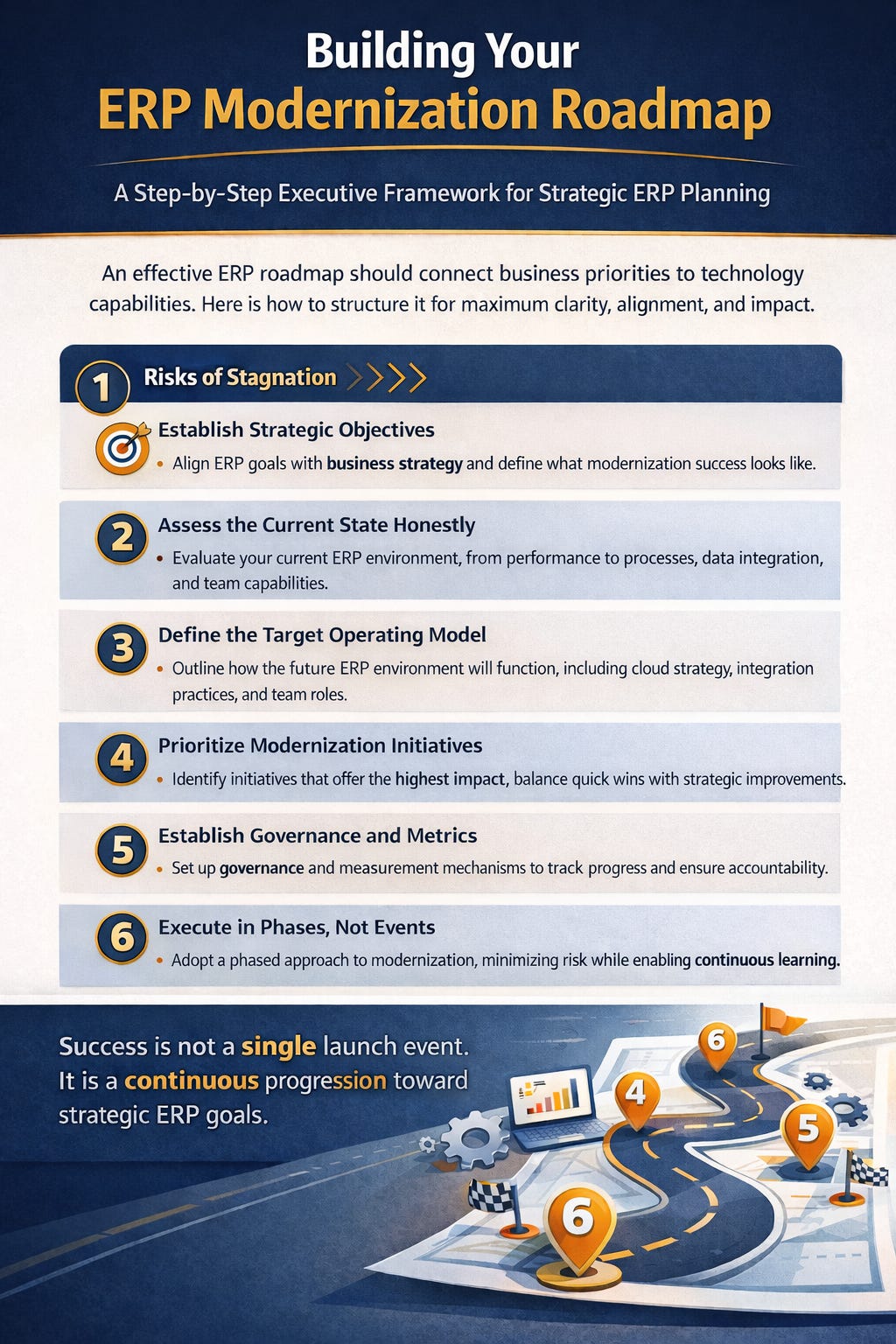
Step 1: Establish Strategic Objectives
Every effective roadmap begins with a clear articulation of strategic objectives. These objectives should reflect both business priorities and operational realities. CIOs need to define what modernization is meant to achieve, whether that is increased agility, cost optimization, improved data visibility, or enhanced user experience. Without this clarity, it becomes difficult to evaluate tradeoffs or measure success.
Strategic objectives also help align stakeholders. Business leaders, finance teams, and IT organizations often have different expectations for ERP outcomes. A shared set of objectives ensures that decisions are evaluated against consistent criteria. This alignment reduces friction later in the roadmap. It also strengthens executive sponsorship and accountability.
Step 2: Assess the Current State Honestly
An honest assessment of the current ERP environment is essential. This assessment should go beyond infrastructure and include processes, integrations, data quality, and team capabilities. Many organizations underestimate the strength of what they already have. Others overlook areas where technical debt or inefficiency has accumulated.
A comprehensive assessment should include:
Core system stability and performance metrics
Integration landscape and data flow complexity
Customizations and their business value
This level of visibility allows CIOs to separate perception from reality. It also highlights areas where modernization can deliver immediate value. Without this baseline, roadmap decisions are based on incomplete information.
Step 3: Define the Target Operating Model
The target operating model describes how the ERP environment will function in the future. It includes decisions about cloud strategy, integration patterns, governance, and team structure. This model is not about specific tools. It is about defining how work gets done and how systems interact.
A well-defined operating model provides a blueprint for modernization. It clarifies roles and responsibilities across IT and business teams. It also establishes standards for deployment, monitoring, and change management. These standards reduce variability and improve predictability.
CIOs should ensure that the operating model supports both stability and innovation. The goal is not to optimize for one at the expense of the other. A balanced model enables continuous progress without introducing unnecessary risk.
Step 4: Prioritize Modernization Initiatives
Once objectives and operating models are defined, the next step is prioritization. Not all modernization efforts deliver equal value. CIOs must identify initiatives that provide the highest impact with manageable risk. This requires evaluating both technical complexity and business benefit.
Effective prioritization often focuses on areas such as:
Infrastructure modernization to improve scalability and cost efficiency
Integration improvements to accelerate data flow and reduce friction
Automation initiatives that reduce manual effort and increase reliability
These initiatives create momentum without requiring large-scale disruption. They also build confidence across stakeholders. Over time, this approach allows organizations to modernize incrementally while maintaining operational continuity.
Step 5: Establish Governance and Metrics
Governance is the mechanism that keeps the roadmap on track. It ensures that decisions align with strategic objectives and that progress is measurable. Without governance, even well-designed roadmaps can drift. CIOs need to define how decisions are made, how priorities are adjusted, and how success is evaluated.
Metrics play a critical role in this process. They provide visibility into whether modernization efforts are delivering the intended outcomes. Metrics should go beyond uptime and include delivery speed, cost efficiency, and business impact. Clear measurement reinforces accountability and supports continuous improvement.
Strong governance also creates transparency. Stakeholders can see how decisions are made and how progress is tracked. This visibility builds trust and reduces resistance to change.
Step 6: Execute in Phases, Not Events
ERP modernization should be implemented in phases rather than as a single transformation event. Phased execution reduces risk by limiting the scope of change at any given time. It also allows organizations to learn and adapt as they move forward. Each phase builds on the previous one, creating a cumulative effect.
Phased approaches also improve resilience. If a particular initiative encounters challenges, it does not derail the entire roadmap. CIOs can adjust priorities and timelines without compromising overall strategy. This flexibility is essential in complex environments.
Over time, phased execution creates a pattern of continuous improvement. The organization becomes more comfortable with change and better able to manage it. This capability is one of the most valuable outcomes of a well-designed roadmap.
Turning Strategy into Sustained Progress
An effective ERP modernization roadmap is not a static document. It is a living framework that evolves with the organization. CIOs who approach modernization as a continuous process are better positioned to adapt to change and capture new opportunities. They avoid the pitfalls of both stagnation and overreach.
The ultimate goal is not modernization for its own sake. It is the ability to deliver consistent, measurable value to the business. A well-structured roadmap provides the clarity and discipline needed to achieve that goal.